EN
EN  it
it
The growing pressure on water resources is redefining the way territories, utilities, institutions and industrial operators plan the water cycle. In many areas, resource availability can no longer be considered a stable factor: drought, rising consumption, competition between civil, agricultural and industrial uses, and greater climate variability require a rethink of water infrastructure in a more flexible, integrated and efficient direction.
In this scenario, treated wastewater reuse, desalination, large water transmission networks, applied research, advanced treatment and energy efficiency represent complementary levers of the same transformation. The issue is no longer only to guarantee new water availability, but to build systems capable of recovering water where it is already present, producing new water when conventional sources are not sufficient, improving its quality through advanced processes and reducing the energy burden of plants.
In France, wastewater reuse enters territorial planning
One of the most concrete directions concerns treated wastewater reuse. In Argelès-sur-Mer, in southern France, this solution has been applied in an area where water scarcity, agricultural activities and tourism pressure affect the same local system. Treated water is no longer managed exclusively as wastewater to be treated and discharged, but as a recoverable resource to be reintroduced into a controlled use cycle.
The project was promoted by the Communauté de communes Albères-Côte Vermeille-Illibéris, an intermunicipal authority bringing together several municipalities in the area. The plant enables the reuse of up to 1.3 million cubic metres of treated wastewater per year, intended for the irrigation of around 650 hectares of farmland and benefiting approximately 60 farmers.
Treatment is carried out through ultrafiltration, a membrane process that separates particles and microorganisms from water, making it compatible with the standards required for agricultural reuse. In the French project, the water reaches Category A, the highest quality level required for this type of application.
Water reuse thus becomes part of the operational management of the territory: it reduces pressure on conventional sources, supports agricultural supply chains and enhances the value of a resource already present in the urban cycle. This is a relevant step, especially in Mediterranean areas, where seasonality, drought and rising demand make the ability to recover already available water volumes increasingly strategic.
In Jordan, desalination supports national water security
When the recovery of existing resources is not enough, desalination becomes an infrastructure lever to generate new water availability. Jordan, one of the countries most exposed to water scarcity, is intervening through the National Water Carrier Project, a major project designed to strengthen supply at national level.
The project includes the construction of a desalination plant on the Red Sea and a pipeline network approximately 450 kilometres long, intended to transport drinking water to Amman and other areas of the country. The objective is to reach, from 2030, around 300 million cubic metres of additional drinking water per year.
The project financing includes KfW, the German public development bank. KfW operates on behalf of the German federal government and supports projects with economic, social, environmental and international cooperation objectives. In the case of the National Water Carrier Project, the agreement provides for 127 million euros: 102 million in grants and 25 million through a debt swap mechanism, meaning the conversion of part of the debt into resources allocated to development initiatives.
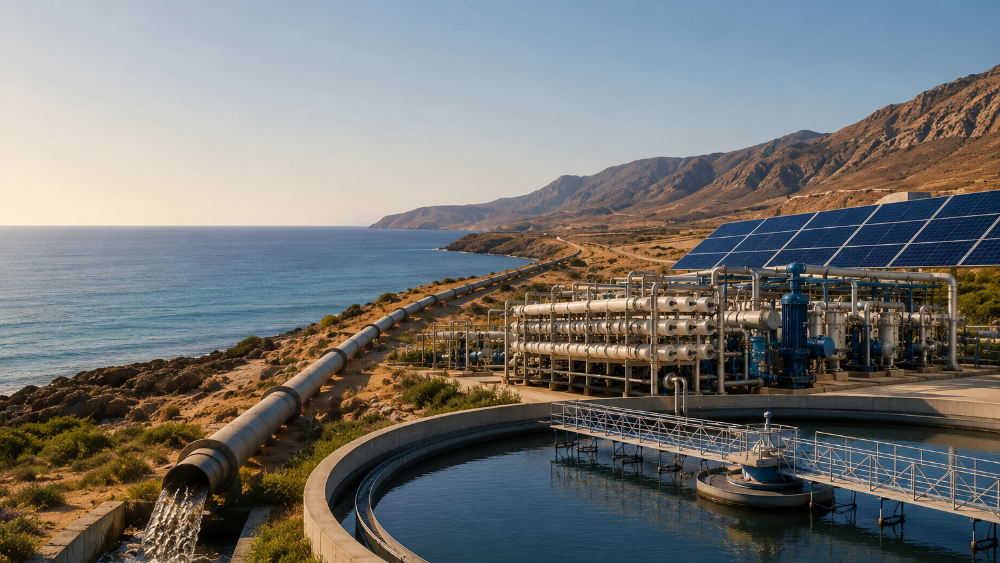
In this context, desalination is not only a treatment technology. It becomes part of a strategy that integrates new water production, transmission, distribution and supply security. The presence of photovoltaic systems covering part of the energy requirement also confirms the central role of the water-energy nexus in the design of major water infrastructure projects.
In Kuwait, desalination takes on an industrial scale
The same need for new water availability emerges in Kuwait, with a more distinctly industrial dimension. The new Doha SWRO Desalination Plant, Stage II, worth around 372 million dollars, concerns the construction of a large-scale desalination plant designed to integrate engineering, construction, commissioning and operational management activities. The plant will be based on SWRO technology, Seawater Reverse Osmosis, meaning reverse osmosis applied to seawater. The process involves passing seawater through semipermeable membranes that retain salts and impurities, producing usable freshwater.
The planned capacity is 60 MIGD, Million Imperial Gallons per Day, a unit of measurement used in the desalination and water treatment sector to indicate the daily volume produced or treated by a plant. Since one million imperial gallons corresponds to approximately 4.5 million litres, a capacity of 60 MIGD is equivalent to around 273 million litres per day.
The contract includes design, engineering, procurement, construction and commissioning of the plant, activities referred to in the sector by the acronym EPC, Engineering, Procurement and Construction. A five-year O&M, Operation and Maintenance, period is also planned. The plant will also include a recarbonation system, used after desalination to rebalance certain chemical characteristics of the water and make it more suitable for distribution and end uses.
Here too, the presence of photovoltaic systems supporting part of the energy requirement highlights one of the central issues of desalination: producing new freshwater requires complex infrastructure and significant energy consumption. For this reason, the integration of energy solutions is not an accessory element, but a component of the operational sustainability of the plants.
In Singapore, research and treatment focus on less energy-intensive processes
The relationship between water, technology and energy emerges particularly clearly in Singapore, where water resource management has long been linked to applied research and industrial planning. PUB, the country’s National Water Agency, has obtained almost 100 million dollars under the RIE2030 programme to fund research activities on water technologies.
RIE2030, Research, Innovation and Enterprise 2030, is the national programme through which Singapore supports research, innovation and industrial development in sectors that are strategic for the country’s competitiveness and resilience. In the water sector, the funding covers solutions for the municipal water cycle, treatment, desalination, emerging contaminants and industrial water.
The main share of the resources, amounting to 85 million dollars, is allocated to municipal water solutions, while 12 million is reserved for industrial water solutions. The latter line focuses in particular on water-intensive sectors, such as semiconductor manufacturing and data centres, where water, energy and operational continuity are closely interdependent.
The planned initiatives also include an Integrated Validation Plant for wastewater treatment with an energy-positive objective. The plant is intended to validate solutions capable of significantly reducing the energy requirement of treatment and, where possible, generating or recovering more energy than is consumed in the process.
Singapore is therefore expanding the scope of water management: not only physical infrastructure and resource availability, but also research, testing, laboratory analysis of industrial water and emerging contaminants, and reduction of the energy intensity of processes.
In Italy, energy efficiency enters water service management
The issue of energy efficiency also directly concerns the Italian integrated water service. Wastewater treatment, drinking water treatment, lifting, pumping and distribution are industrial activities that affect utility consumption and the economic and environmental sustainability of the service.
This is the context for the path undertaken by Pavia Acque, manager of the integrated water service in the province of Pavia. The company has confirmed the maintenance of its ISO 50001:2018 certification, the international standard for energy management systems. The standard makes it possible to structure a method for measuring consumption, identifying areas for improvement, planning interventions and verifying results over time.
The plan prepared by Pavia Acque provides for investments of around 16.7 million euros, largely intended for the development of new photovoltaic plants. The total planned renewable capacity is 8.5 MW, with estimated energy savings of 2,130 TOE per year and a reduction of around 5,350 tonnes of CO₂ every year.
TOE, tonne of oil equivalent, is a conventional unit used to compare different quantities of energy. In the case of Pavia Acque, the figure makes it possible to measure synthetically the savings achieved through interventions on plants, stations, wastewater treatment facilities and pumping systems.
In 2025, according to the company, the completed interventions generated savings of around 463,000 kWh, equal to 38.99 TOE, with a reduction of approximately 100 tonnes of CO₂. The results concern various assets of the water service, including the Arena Po-Zappellone intermunicipal wastewater treatment plant, the Travacò Siccomario-Rotta plant, the Guallina di Mortara station and the Brodolini Well in Vigevano, with consumption reductions ranging from 14% to over 40%.
Pavia Acque’s path confirms the importance of the water-energy nexus: improving the efficiency of the water service also means containing consumption, costs and emissions, while strengthening the operational sustainability of existing infrastructure.
From reuse to desalination, the water cycle becomes more integrated
The experiences of France, Jordan, Kuwait, Singapore and Italy describe different levels of the same transformation. Reuse makes it possible to recover water already present in the urban or territorial cycle. Desalination enables new availability to be created from seawater. Large water infrastructure makes it possible to transport the resource where it is needed. Applied research works on more efficient technologies and lower-energy-impact processes. Finally, energy efficiency makes the daily management of existing plants more sustainable.
The common thread is not a single technology, but the need to make the water cycle more adaptable to increasingly complex climatic, environmental and production conditions. In territories under water stress, acting on a single lever is not enough: systems are needed that can combine recovery, production, treatment, distribution and efficiency.
The relationship between water and energy runs through all these stages. Reuse, desalination, treatment, lifting and distribution are activities that require energy. For this reason, the integration of renewables, process optimisation and consumption reduction become structural elements of the water strategy, not separate components.
The nineteenth edition of ACCADUEO in Bari: discussion on water, energy and resilient infrastructure
The nineteenth edition of ACCADUEO will take place in Bari, at the Nuova Fiera del Levante, on 26 and 27 November 2026. The event confirms its role as a reference appointment for the civil and industrial water sector, creating an opportunity for discussion among companies, utilities, institutions, technical professionals and the research community.
In this context, wastewater reuse, desalination, energy efficiency, advanced treatment and integrated resource management will be central topics for operators called upon to address water scarcity and quality, service continuity, process sustainability and infrastructure resilience.
ACCADUEO represents a meeting point between skills, technologies and management models linked to the evolution of water infrastructure: from reuse to wastewater treatment, from desalination to energy efficiency, through to strategies for making networks, plants and territories more resilient.
In a sector where water and energy are increasingly interdependent, discussion among operators, institutions and companies becomes essential to understand market evolution, identify solutions applicable to different territorial contexts and accelerate the transition towards more efficient, secure and sustainable water management.
Sources
H2O Global News – France’s Largest Wastewater Reuse Scheme for Agriculture Opens at Argelès-sur-Mer
https://h2oglobalnews.com/argeles-sur-mer-wastewater-reuse-agricultural-irrigation/
Veolia Water Technologies – Argelès-sur-Mer, France’s largest treated wastewater reuse project
Smart Water Magazine – France’s largest agricultural wastewater reuse project goes live
Petra – Jordan, KfW sign €127m grant agreement to support National Water Carrier Project
Green Climate Fund – Jordan Aqaba-Amman Water Desalination and Conveyance Project
https://www.greenclimate.fund/project/fp288
Jordan Times – Water Ministry, KfW sign agreement to implement National Water Carrier grant
Gulf Construction – WABAG JV wins $372m Kuwait desalination plant contract
Zawya – Kuwait confirms award of Doha desalination plant Phase 2 to HEISCO-WABAG JV
Smart Water Magazine – Kuwait awards $372 million desalination contract to WABAG joint venture
PUB Singapore – Funding under RIE2030 for water technologies research
National Research Foundation Singapore – Research, Innovation and Enterprise 2030
https://www.nrf.gov.sg/rie2030/
Water & Wastewater Asia – PUB awarded nearly $100m under RIE2030
Pavia Acque – Press release “Pavia Acque consolidates its energy efficiency path: ISO 50001 confirmed”, 24 June 2026
Energia Oltre – Pavia Acque consolidates its energy efficiency path
Unoenergy Green Solutions – Pavia Acque and energy transition