EN
EN  it
it

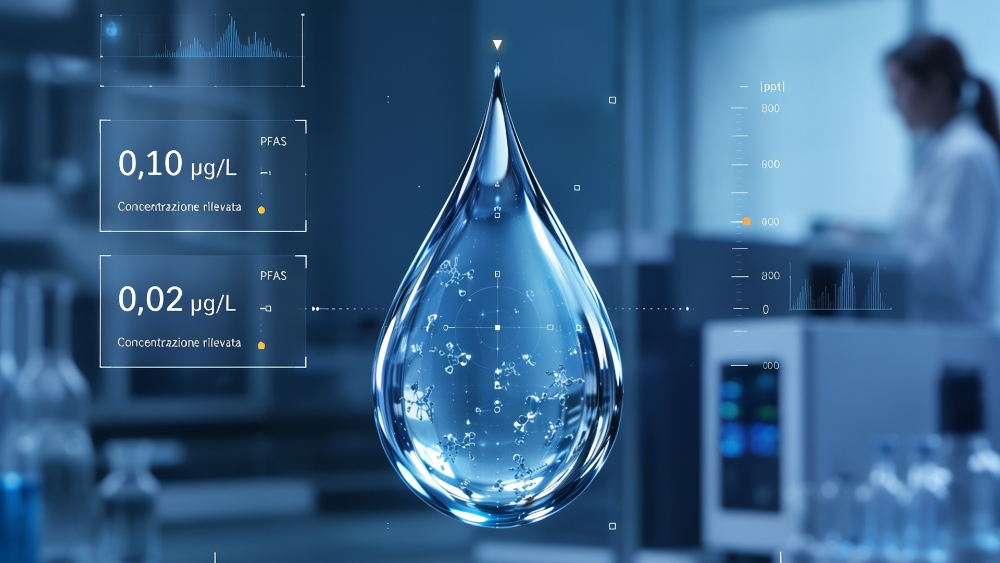
Drinking water quality increasingly depends on the ability to detect substances present at very low concentrations and assess their risks throughout the entire supply chain.
Among the most significant cases are PFAS, substances that are highly persistent and difficult to break down, and which are being investigated with increasing attention in water, soil, wastewater and sewage sludge.
For water utilities and laboratories, this means defining up-to-date monitoring programmes and identifying appropriate analytical methods and effective treatment technologies that are also sustainable from both an energy and economic perspective.
How drinking water controls are changing
Legislative Decree 102/2025 updated the Italian regulatory framework for water intended for human consumption, supplementing Legislative Decree 18/2023 and the transposition of European Directive 2020/2184.
As highlighted by TÜV Italia in an analysis republished by AgenSalute, the new framework strengthens prevention and risk management.
Water quality is monitored not only at the end of the treatment process, but throughout every stage, from abstraction to drinking water treatment and distribution, through to internal building water systems.
Two parameters are established for PFAS:
- 0.10 µg/L for the sum of the PFAS covered by the legislation;
- 0.02 µg/L for the sum of PFOA, PFOS, PFNA and PFHxS, the four compounds considered a priority.
As of 13 July 2026, monitoring of the four priority PFAS and controls on the ADV substances provided for under national legislation have become operational. From 13 January 2027, monitoring of TFA will become mandatory, with a reference value of 10 µg/L.
The adjustment directly involves laboratories: analysing substances at very low concentrations requires high-sensitivity instruments, controlled sampling and methods capable of producing reliable and comparable results.
The role of supply-chain operators and the importance of materials and technologies
Water quality depends not only on the resource at its source, but also on the technologies used during treatment, the materials and products in contact with drinking water, and the proper management of systems and facilities.
For this reason, the legislation also addresses these aspects. The provisions cover, among other items, chemical reagents, filter materials and components used in treatment and distribution systems. The ReMaF system will be required to ensure their compliance and traceability.
The fight against micropollutants involves water utilities, laboratories, technology manufacturers, material suppliers, designers, managers of internal water systems and supervisory authorities.
By highlighting potential critical issues, analytical results support the updating of monitoring programmes and guide operational decisions.
Why downstream action alone is not sufficient
The strengthening of controls coincides with studies highlighting the costs and limitations of PFAS remediation.
The study PFAS remediation across Europe: costs and limited impacts, published in Environmental Science: Processes & Impacts, analysed several intervention scenarios across Europe.
To address historical contamination from long-chain PFAS in European Union countries, the study estimates a cost of approximately €37 billion over twenty years.
Under a broader scenario, also covering new PFAS and interventions involving contaminated sites, drinking water, wastewater, sludge and leachate, costs could reach between €52 billion and €200 billion per year.
Despite the scale of the investment, the measures considered would capture only a very limited share of current emissions.
Removal technologies remain essential in contaminated areas, but remediation alone cannot be relied upon once these substances have entered the environment.
What is therefore needed is prevention, emission reduction at source, monitoring and accountability on the part of organisations that produce or use these substances.
Treatment technologies, energy consumption and costs
The choice of technology does not depend solely on its ability to remove a specific contaminant.
Other key factors include incoming water quality, the concentrations to be treated, filter media service life, the residuals produced, maintenance and service continuity.
Membranes, adsorption systems and oxidation processes can deliver different results depending on the characteristics of the water and the treatment facility.
These factors must also be considered alongside energy consumption and the cost per cubic metre treated: a solution that is effective in the laboratory may be difficult to apply to large volumes or may prove unsustainable over the long term.
The assessment must therefore combine removal effectiveness, reliability, energy consumption, maintenance and the impact on the cost of the service.
The Acquedotto Pugliese case
A practical example of the introduction of the new parameters into analytical activities comes from central and southern Italy.
In the test report dated 24 April 2026 concerning treated water leaving the Fortore drinking water treatment plant, Acquedotto Pugliese’s Multi-site Laboratory included testing for TFA, individual PFAS molecules, the sum of the four priority compounds and the total sum of PFAS.
The analyses were performed in accordance with UNI EN 17892:2024.
In the sample examined, TFA was measured at 2 ± 1 µg/L, while both the sum of the four priority PFAS and the total sum of PFAS were below 0.001 µg/L.
The results apply only to the sample analysed; however, they show that these parameters have already been incorporated into the monitoring protocols of a major water utility.
Acquedotto Pugliese manages the integrated water service in Apulia and twelve municipalities in Campania, serving more than four million people. In 2025, it tested approximately 55,000 samples and 1.7 million chemical and microbiological parameters.
Through a Control Room, AQP collects data from networks, facilities and sensors, integrating them with GIS systems, IoT tools and digital models. The new controls are therefore part of a complex system in which analysis, infrastructure, source availability and energy consumption are closely interconnected in the operation of networks, facilities and processes.
PFAS throughout the entire water cycle
PFAS do not only affect drinking water.
They can reach wastewater treatment plants, accumulate in sludge and affect the potential for treated water reuse.
The agreement between ENEA and the Italian Ministry of the Environment and Energy Security allocates €2.5 million to the monitoring of PFAS in wastewater and sewage sludge and to the development of removal technologies.
The programme includes analysing the presence of contaminants, assessing available technologies and developing innovative bioremediation processes.
Part of the programme also focuses on the potential risks associated with the reuse of wastewater in agriculture.
The project confirms the need to track PFAS throughout the entire water cycle: from supply sources and drinking water treatment through to wastewater treatment, sludge management and reuse.
A challenge requiring investment and shared responsibility
Compliance with the new monitoring requirements is taking place within a European sector already facing ageing infrastructure, climate change and rising energy costs.
Investment must be strengthened and action taken at the sources of pollution, so that the costs of advanced treatment do not fall entirely on water utilities and users.
The “polluter pays” principle therefore becomes central. The water service must guarantee water quality, but cannot be regarded as solely responsible for substances released into the environment by other industrial activities.
The issue of investment and infrastructure resilience had already been examined in the Accadueo article “The European water sector is at a crossroads”. The PFAS case clearly demonstrates how regulatory and environmental changes generate new operational requirements for water utilities and laboratories.
The discussion continues at Accadueo
Monitoring, data reliability, technology selection and energy efficiency will be among the key topics at Accadueo 2026.
On 26 November, from 2:00 p.m. to 3:30 p.m., in the Ocean Room, AQUA ITALIA will organise the conference:
“Micropollutants and energy efficiency under the new Drinking Water Directive: technological solutions from industry for water utilities”.
The conference will examine solutions for micropollutants and the relationship between removal effectiveness, energy consumption and operating costs: membrane systems, adsorption, oxidation processes and digital tools for plant monitoring, together with the related economic and management considerations.
An effective technology for tackling PFAS will instead be presented on 27 November in the Goccia Room, from 10:15 a.m. to 10:45 a.m., during a presentation by exhibitor Chemviron Italia Srl: “Thermal destruction of PFAS during the full-scale reactivation of PFAS-contaminated granular activated carbon (GAC)”.
The special Accadueo Labs area will also be dedicated to laboratories, measuring instruments and technologies for water-quality monitoring.
The initiative will bring together companies and experts representing associations, universities and the research community to present state-of-the-art solutions and share best practices in chemical, biological and microbiological analysis, emerging contaminant detection, sampling and method validation.
Accadueo will take place on 26 and 27 November 2026 at the Nuova Fiera del Levante in Bari.
Sources
Legislative Decree No. 102 of 19 June 2025 — Italian Official Gazette
TÜV SÜD — Drinking Water Directive and Legislative Decree 102/2025
Acquedotto Pugliese — Treated water test report, Fortore plant
Acquedotto Pugliese — 2025 Integrated Report
Acquedotto Pugliese — Press release on the 2025 Integrated Report
Acquedotto Pugliese — July 2026 press kit
ENEA — ENEA-MASE agreement to tackle PFAS pollution in wastewater
Watergas — ENEA-MASE: PFAS monitoring and removal technologies